
When it comes to your home’s electrical service, do you know where your responsibility begins and where Alliant Energy’s ends? If you’re like most homeowners, this question might not cross your mind until something goes wrong—and that’s when confusion can turn into costly delays and frustration.
At T.A.P. Electric, we want to empower you with the knowledge you need to maintain your home’s electrical system safely and effectively. Understanding the division of responsibilities between you and your utility provider is essential for proper maintenance, timely repairs, and keeping your family safe.
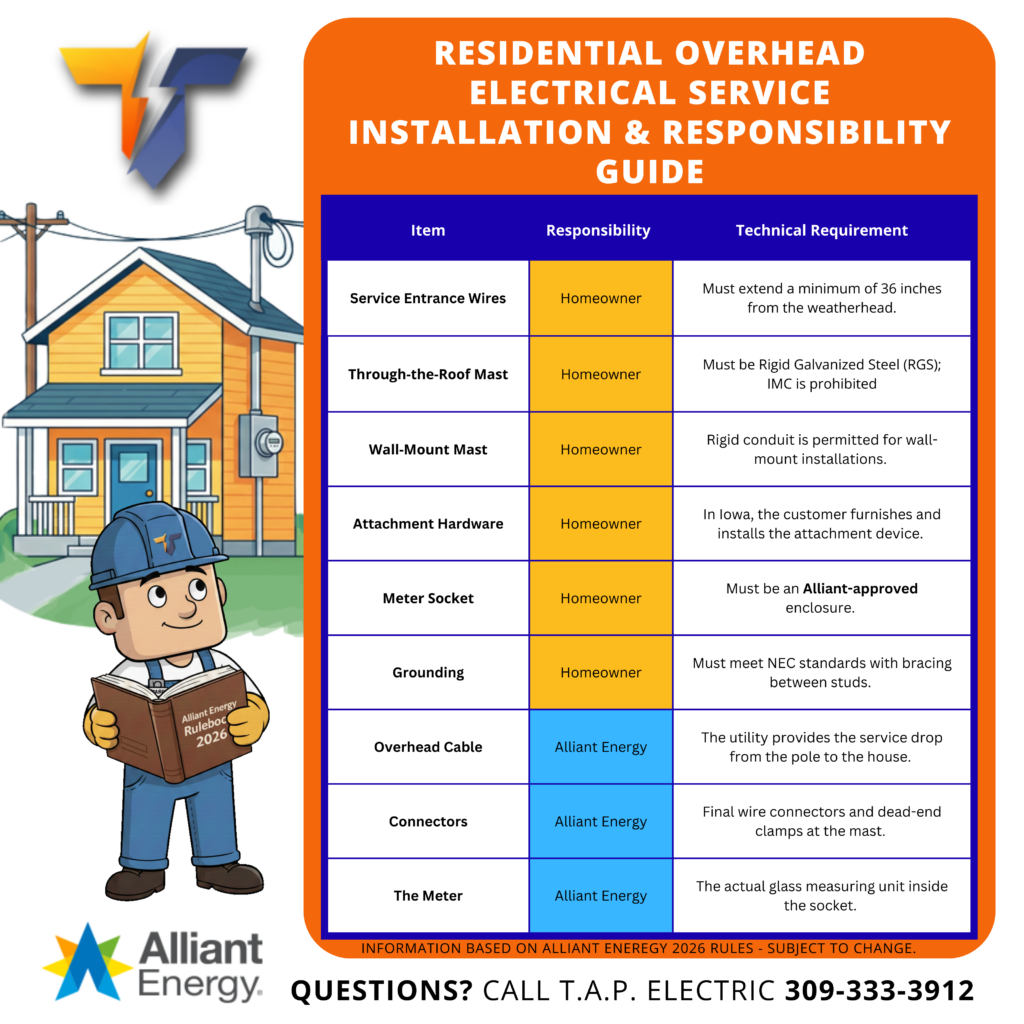
The Dividing Line: What’s Yours, What’s Theirs
When you look at the electrical service connecting your home to the power grid, there’s a clear (though not always obvious) dividing line between homeowner and utility company responsibilities. Understanding this distinction helps you know exactly who to call when issues arise.
A Simple Rule of Thumb
Here’s an easy way to remember: If it’s attached to your house, it’s typically your responsibility. If it’s coming from the utility pole to your connection point, it belongs to Alliant Energy.
What Homeowners Are Responsible For
As a homeowner, you’re responsible for maintaining and repairing everything from the point where Alliant Energy’s service drop connects to your home, all the way through to your home’s interior electrical system. Let’s break down each component:
1. Service Entrance Wires
These are the wires that run from your weatherhead (the cap on top of your service mast) down to your meter socket.
Technical Requirement: These wires must extend a minimum of 36 inches from the weatherhead to meet code requirements.
What to Watch For: Look for fraying, exposed wire, or damage from weather or wildlife. If you notice any issues, contact a licensed electrician immediately.
2. Through-the-Roof Mast
This is the vertical pipe that extends through your roof and holds your service entrance wires at the proper height.
Technical Requirement: Must be Rigid Galvanized Steel (RGS). Intermediate Metal Conduit (IMC) is prohibited for through-roof installations.
Common Issues: Storm damage, rust, or structural weakness from age. The mast must be strong enough to support the weight and tension of the service wires.
3. Wall-Mount Mast
If your service entrance is mounted on the side of your home rather than going through the roof, you have a wall-mount mast.
Technical Requirement: Rigid conduit is permitted for wall-mount installations, giving you slightly more flexibility than through-roof installations.
Maintenance Tip: Check mounting brackets regularly to ensure they’re secure and that the mast remains properly aligned.
4. Attachment Hardware
This includes the bracket or eye bolt that secures Alliant Energy’s service drop cable to your home.
Important Note for Iowa Residents: In Iowa, the customer furnishes and installs the attachment device. This is different from some other service territories, so it’s important to know your local requirements.
5. Meter Socket
This is the box mounted on the exterior of your home that holds the electrical meter (the meter itself belongs to Alliant Energy, but the socket that holds it is yours).
Technical Requirement: Must be an Alliant-approved enclosure. Not all meter sockets are created equal, and using an approved model ensures compatibility and safety.
Maintenance Considerations: Meter sockets can crack, develop loose connections, or suffer weather damage over time. Any damage to the socket requires immediate attention from a licensed electrician.
6. Grounding System
Your electrical system’s ground is a critical safety component that provides a path for fault current and protects your home from electrical surges.
Technical Requirement: Must meet National Electrical Code (NEC) standards with proper bracing between studs.
Why It Matters: A proper ground protects you from electrical shock, helps prevent fires, and protects your electronics and appliances from power surges.
What Alliant Energy Is Responsible For
Alliant Energy maintains the equipment that delivers power from their distribution system to your home’s connection point. Here’s what falls under their jurisdiction:
1. Overhead Cable
This is the utility line that runs from the utility pole to your home, often called the “service drop.”
Alliant Energy’s Role: The utility provides and maintains the service drop from the pole to your house. If you notice this cable sagging, showing signs of damage, or if it’s been struck by a tree limb, contact Alliant Energy directly.
2. Connectors
These are the hardware components where the service drop connects to your service entrance wires at the mast.
What They Include: Final wire connectors and dead-end clamps at the mast. While these are Alliant Energy’s responsibility, it’s still good practice to visually inspect this connection point for obvious issues.
3. The Meter
This is the actual glass measuring unit inside your meter socket that records your electrical usage.
Important Distinction: While the meter belongs to Alliant Energy and they’re responsible for maintaining and reading it, the socket that holds the meter is your responsibility. If you suspect a meter problem, contact Alliant Energy. If the socket is damaged, call your electrician.
Why Understanding These Responsibilities Matters
Knowing who’s responsible for what isn’t just about passing the buck—it’s about:
Getting Help Faster: When you know who to call, you can get issues resolved more quickly, minimizing downtime and safety risks.
Proper Maintenance: Understanding your responsibilities helps you maintain your equipment properly and catch small issues before they become major problems.
Avoiding Surprise Costs: Calling Alliant Energy for something that’s your responsibility (or vice versa) can lead to delays, service calls you’ll be charged for, or repairs that don’t get done.
Safety First: Electrical issues can be dangerous. Knowing the proper channels ensures that qualified professionals handle each component appropriately.
Code Compliance: When you make repairs or upgrades to your equipment, understanding the technical requirements helps ensure your work meets local codes and passes inspection.
Common Scenarios: Who Do You Call?
Let’s look at some real-world situations and who you should contact:
Scenario 1: A storm damages your mast
- Who to call: A licensed electrician (like T.A.P. Electric)
- Why: The mast is your responsibility, and it must be repaired to proper code before Alliant Energy can reconnect service.
Scenario 2: The overhead cable is sagging low over your driveway
- Who to call: Alliant Energy
- Why: The overhead cable is their responsibility to maintain.
Scenario 3: Your meter socket is cracked
- Who to call: A licensed electrician
- Why: The socket is homeowner equipment, even though the meter inside belongs to the utility.
Scenario 4: You’re getting inconsistent power or flickering lights
- Who to call: Start with a licensed electrician
- Why: Most power quality issues originate on the homeowner’s side. An electrician can diagnose the problem and determine if it’s actually a utility issue.
Scenario 5: Tree branches are touching the service drop
- Who to call: Alliant Energy
- Why: Only utility workers or specially trained arborists should work near high-voltage lines.
When to Call T.A.P. Electric
At T.A.P. Electric, we specialize in all aspects of homeowner electrical service, including:
- Service entrance repairs and upgrades
- Mast replacement (both through-roof and wall-mount)
- Meter socket replacement and repair
- Service wire replacement
- Grounding system installation and repair
- Service capacity upgrades (from 100A to 200A, for example)
- Storm damage assessment and repair
- Pre-inspection services to ensure your equipment meets code
We work closely with Alliant Energy to ensure seamless service connections and reconnections when work needs to be coordinated between both parties.
Maintenance Tips for Homeowners
Even if you’re not experiencing problems, it’s wise to periodically inspect your electrical service components:
Annual Visual Inspection: Once a year, take a walk around your home and visually inspect all visible electrical equipment. Look for:
- Rust or corrosion on metal components
- Cracks in the meter socket
- Frayed or damaged wires
- Loose mounting brackets
- Vegetation growing too close to equipment
After Major Storms: Always inspect your electrical service equipment after severe weather, especially:
- High winds that could damage the mast
- Ice storms that add weight to lines
- Lightning strikes in your area
- Falling tree limbs or debris
Before Home Projects: If you’re planning any home improvements—especially roof work, siding replacement, or additions—consult with an electrician about how it might affect your electrical service entrance.
Never DIY These Repairs: Electrical service equipment carries the full voltage from the utility—typically 240 volts at 100 amps or more. This is not the place for DIY repairs. Always hire a licensed, insured electrician for any work on your service entrance equipment.
Planning an Upgrade?
If your home has older electrical service equipment, you might want to consider an upgrade even if nothing is currently wrong. Here are signs it might be time:
- Your home has a 60-amp or 100-amp service and you’re planning major renovations or additions
- Your meter socket or mast is heavily rusted or corroded
- Your service entrance doesn’t meet current code requirements
- You’re adding high-demand appliances like electric vehicle charging, a hot tub, or central air conditioning
- Your service equipment is more than 40 years old
Upgrading your electrical service can improve safety, increase your home’s value, and provide the capacity you need for modern living.
Have Questions? We’re Here to Help
At T.A.P. Electric, we believe that informed customers make better decisions about their home’s electrical systems. Whether you need an emergency repair, routine maintenance, or just have questions about your responsibilities, we’re here to provide friendly, expert guidance.
Understanding the division of responsibilities between you and Alliant Energy empowers you to take proper care of your home’s electrical system and respond quickly when issues arise. Remember: when in doubt, it’s always better to ask a professional than to guess—especially when it comes to electrical safety.
Contact T.A.P. Electric today for:
- Free consultations on electrical service questions
- Emergency service when you need it most
- Scheduled maintenance and inspections
- Service upgrades and repairs
- Expert guidance on code requirements
Your home’s electrical system is too important to leave to chance. Let our licensed professionals help you keep the lights on safely and reliably.