
It’s one of the most reasonable things a homeowner can think: the panel still works, the lights still come on, so the upgrade can wait until next year. Money’s money, and putting off a big bill feels like keeping it in your pocket. Most of the time, though, waiting doesn’t keep the money in your pocket. It just changes who you’re writing the check to, and how big the check is. Here’s the honest math on why holding off on electrical work usually costs more than doing it, and the times when waiting really is the right call.
The number rarely sits still
When you get a price on electrical work today and decide to think about it, it’s easy to picture that same number waiting patiently for you next spring. It isn’t. Two things underneath every electrical quote have been climbing steadily, and neither one is in a hurry to reverse.
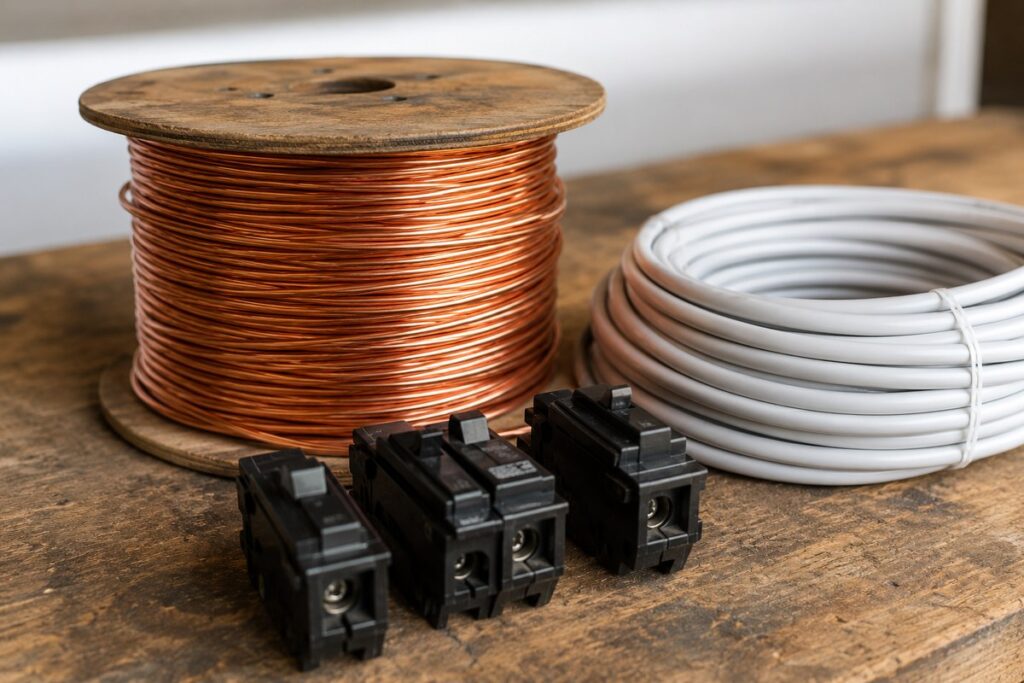
The first is material. Copper is the metal inside nearly every wire we pull, and copper has gotten a lot more expensive. Electrical wire jumped again in the first half of 2026, and it’s running close to 18 percent higher than it was a year ago. Step back further and the picture is sharper: copper wire and cable costs roughly 84 percent more than it did back in early 2020. New tariffs on copper coming into the country, up to 50 percent on some of it, are pushing the same direction. Wire, breakers, conduit, panels, all of it rides on those raw-material prices, and construction material costs as a whole climbed at better than a 12 percent annual pace early this year.
The second is labor. Skilled electricians are in short supply and high demand. Data centers, EV chargers, and grid work are pulling licensed electricians toward big projects, a wave of experienced hands is retiring, and training programs aren’t turning out replacements fast enough. When something is scarce, it costs more. Electrician pay has been rising a few percent a year, and construction wages overall are up better than 3 percent from last year. Those are real numbers on the Bureau of Labor Statistics sheet, and they show up in what any honest shop has to charge to keep good people.
And it isn’t only market drift. A lot of electrical labor is set by pay agreements that raise wages a fixed amount every year, so the labor side of a quote tends to climb on a schedule rather than only when demand spikes. It’s one more reason the number you get this fall is unlikely to be waiting for you next fall.
Put those two together and the quote you’re sitting on is more likely to be a floor than a ceiling. The work almost never gets cheaper by waiting. It gets more expensive at about the speed the calendar moves.
Will a small problem stay small if I wait?
Sometimes. Often, no. This is the part that costs homeowners the most, and it has nothing to do with copper prices.
Electrical problems tend to run one direction: a warm breaker becomes a scorched one, a flickering circuit becomes a dead one, a panel that’s just old becomes a panel that fails on the coldest night of the year. When that happens, you’re not scheduling a planned upgrade anymore. You’re making an emergency call, on a nights-or-weekends timeline, on the electrician’s terms instead of yours. The planned version of a job is almost always cheaper and calmer than the emergency version of the same job.
There’s a second cost that hides here too. Once a small issue turns into a real failure, it can take other things with it: a fried appliance, water damage from a sump pump that quit, a freezer full of food, a few days in a hotel while things get sorted. None of that shows up on the original quote. All of it shows up on the delayed one.
We hear the questions behind this all the time. Why does my breaker keep tripping? Why is my panel making a buzzing sound? How often should a panel even get replaced? Those aren’t idle questions. They’re usually a house telling you it’s closer to the emergency version of the job than the planned one.
When waiting really is the right call
Now the other side, because ducking it would make everything above sound like a sales pitch, and it isn’t one.
Not every electrical job is urgent, and a good electrician will tell you so. If your panel is sound, your wiring is in good shape, and the work you’re weighing is an upgrade for convenience rather than safety, waiting a season to budget for it is a perfectly reasonable decision. Adding a circuit for a hot tub you haven’t bought yet, running power to a garage you’re still framing, upgrading to feed an EV you’re planning to get next year: those can sit until the timing and the money line up for you. The material and labor creep still applies, so the job likely costs a little more later. But “a little more later” is a fair trade for doing it when you’re actually ready.
The line we’d draw is safety. If waiting means living with a known hazard, an overloaded panel, aluminum branch wiring, ungrounded outlets, a fuse box the insurance company already flagged, that’s the kind of waiting that tends to get expensive fast, and in ways that matter more than money. If it’s a want and not a risk, waiting is fine. If it’s a risk, the sooner number is almost always the smaller number.
How to actually decide
You don’t need a contractor to make this call for you. You need enough information to make it yourself, which is the whole point.
Get the work looked at and get a real number on it. Ask the electrician a plain question: is this a safety issue or a convenience one? A straight answer tells you which side of the line you’re on. From there it’s arithmetic. A planned job at today’s prices, against a probably-higher price next year, plus the odds of an emergency in between. When it’s a genuine want, that math sometimes favors waiting. When it’s a risk, it rarely does.
For the common jobs, you can start that math before anyone drives out. We publish real prices for our most common work at tap-electric.com/pricing, so you can see roughly where a job lands instead of guessing. If it’s not on that list, the honest answer is that the right number depends on what we find when we look, and we’ll show you what we find before we start, not after. (If you want a feel for how a fair quote actually gets built in the first place, we wrote about that here.)
Waiting isn’t automatically the cheap choice, and doing it now isn’t automatically the smart one. The right answer is whichever one the actual numbers point to for your house. We’re happy to help you find those numbers, whichever way they send you.
If you’re in Southeast Iowa or West Central Illinois and want a straight look at a job you’ve been putting off, T.A.P. Electric is at tap-electric.com. The prices are on the site, the reviews are on Google, and the phone gets answered.
By Brent Allen Strawhacker | Marketing Director, T.A.P. Electric | West Burlington, Iowa