By Brent Allen Strawhacker | Marketing Director, T.A.P. Electric | West Burlington, Iowa
Most people never think about the wiring in their walls until something makes them think about it. A home inspector writes it up. An insurance company asks a question. An outlet gets warm, or half the house goes dark when a fuse blows. Then all of a sudden you want to know what you’ve got back there, and whether it’s something to worry about.
Here’s the good news. You don’t have to be an electrician to get a rough read on your home’s wiring. A lot of it you can spot yourself, from things you can already see, without opening anything up or touching a single wire. This is a plain-language guide to the kinds of wiring you’ll find in older Southeast Iowa homes, how to recognize each one, and, just as important, when it’s actually a problem versus when it’s just old.
One rule before we start: look, don’t poke. You can learn a lot by looking at your outlets, your panel door, and the wiring that’s already visible in an unfinished basement or attic. You do not need to open the panel cover, pull outlets, or handle any wire to do this. If something needs opening up or testing, that’s our job, and it’s the part where people get hurt. Read on the outside, and leave the inside to us.
Why does it matter what wiring you have?
Because your house was probably built for a different life than the one you’re living in it. A home wired in the 1940s was built for a few lights, a radio, and maybe a refrigerator. Now it runs a couple of TVs, a microwave, a window unit, computers, and a dozen things on chargers. Old wiring isn’t automatically dangerous, but it was sized and built for loads that don’t exist anymore, and some of it has quirks worth knowing about.
Knowing what you have helps you in three real ways: safety, because some older types have known weak points; insurance, because carriers ask about certain wiring before they’ll write or renew a policy; and planning, because if you’re thinking about adding a garage, a hot tub, central air, or an EV charger, the wiring you have decides what’s possible.
Start with what you can already see
You can get most of the way there from four things, none of which require tools:
Your outlets. Two slots or three? Grounded or not? That tells you a lot about the era.
Your panel. Does it have screw-in fuses or flip breakers? That’s one of the biggest age tells in the whole house.
The visible runs. In an unfinished basement or attic, you can often see the wiring itself stapled along the joists. The color and covering of that cable is a dead giveaway.
The panel door. Sometimes there’s a label or a stamp that names the service size, like 60, 100, or 200 amps.
Now let’s walk through what you might find.
Knob-and-tube: the oldest of the old
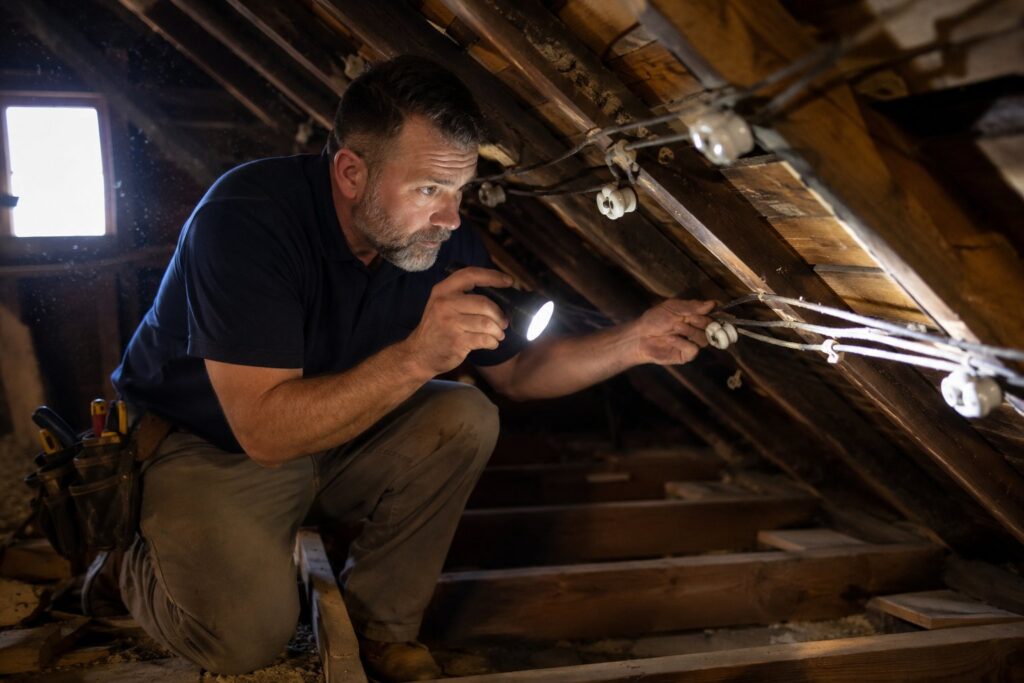
If your home was built before roughly 1950 and hasn’t been fully rewired, you may still have knob-and-tube. It’s easy to recognize once you know it. Instead of a single cable, you’ll see individual wires running through white ceramic knobs that hold them along the joists, and ceramic tubes where they pass through the wood. It looks handmade, because it basically was.
Knob-and-tube can still be carrying power just fine. The trouble is what it lacks and what age does to it. There’s no ground wire, the insulation gets brittle and crumbly after this many decades, and it was never meant to be buried under the blown-in attic insulation that a lot of homes have added since. Insurers have also gotten increasingly reluctant to cover it. We don’t tell people to rip it all out the day they find it, but if you’ve got it, you should know where it is and have a plan. We get into the details on our knob-and-tube replacement page.
Cloth-covered cable: mid-century wiring
A step newer than knob-and-tube, common from about the 1930s into the 1960s, is early nonmetallic cable with a cloth or fabric outer covering. Instead of separate wires on knobs, it’s a single bundled cable, but the jacket is woven fabric rather than the smooth plastic we use now. Under that cloth, the insulation is often an early rubber that turns hard and flaky with age.
A lot of these older runs have no ground, or only a partial one. Cloth-covered cable isn’t automatically a hazard, but where the insulation has gone brittle, or where someone has cut into it over the years for additions, it’s worth having looked at.
Aluminum branch wiring: the 1960s and ’70s wildcard
For a stretch from roughly 1965 to 1973, a lot of homes were wired with solid aluminum instead of copper for the regular branch circuits, the ones feeding your outlets and lights. You can sometimes spot it: the cable jacket may be stamped “AL” or “ALUMINUM,” and where a conductor is visible it looks dull silver rather than the reddish tone of copper.
Aluminum branch wiring isn’t a house on fire waiting to happen, and it’s worth being calm about it. But it does have a known weak point. Aluminum expands, contracts, and oxidizes more than copper, so the connections at outlets, switches, and splices can loosen and heat up over time. The federal Consumer Product Safety Commission has flagged that risk, and the fix is not usually a full rewire. It’s having a licensed electrician check and correct the terminations with the right connectors made for aluminum. One thing that trips people up: the big aluminum cable feeding your meter and main panel is normal and fine. It’s the smaller aluminum branch wiring that gets the attention. More on that on our aluminum wiring repair page.
Modern copper cable: what you want to see
If your home was wired or rewired from the 1970s on, you’re most likely looking at modern copper nonmetallic cable, the smooth plastic-jacketed stuff most people picture. It has a ground wire, it’s sized properly for the breaker protecting it, and on newer installations the jacket is even color-coded by size, white for the 15-amp circuits, yellow for 20-amp, orange for 30-amp. If that’s what you’ve got throughout, your wiring is in good shape and this whole article is just interesting reading.
What your outlets are telling you
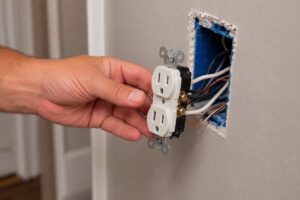
Look at a few outlets around the house. Two-prong outlets, the kind with just two slots and no round hole underneath, are a sign of older, ungrounded wiring. Here’s the part a lot of people get wrong: swapping a two-prong outlet for a three-prong one does not make it grounded if there’s no ground wire behind it. It just looks grounded, which is worse, because now you trust it with things that expect a real ground. There are correct ways to handle an ungrounded circuit, but a plain swap isn’t one of them. We wrote up the how and why of that over on our FAQ page.
What your panel is telling you
Walk up to your electrical panel and just look at the door, no need to open it. If you unscrew fuses to reset a circuit, you’ve got an older fuse panel, often a 60- or 100-amp service, and frequently paired with the older wiring types above. If you flip breakers, you’ve got a more modern setup.
Fuse panels aren’t automatically unsafe, but they carry two catches. They’re usually undersized for a modern household, and they invite a dangerous shortcut: when a fuse keeps blowing, people replace it with a bigger one to make it stop. That doesn’t fix the problem, it removes the safety limit, and now the wiring can overheat before the fuse ever blows. If you’re fighting your fuse box, that’s worth a look. We cover panel and fuse-box upgrades on our panel upgrade page.
So I know what I have. Now what?
Recognizing your wiring is not the same as needing to panic about it. Plenty of older homes run safely for years. The point of learning to read it is knowing when old crosses over into worth-addressing.
Call an electrician when you see the warning signs, not just old wire: outlets or switch plates that feel warm, scorch marks or discoloration, breakers that trip or fuses that blow over and over, a mild shock off an appliance, or a burning smell you can’t place. Those aren’t about the age of the wiring, they’re about something happening right now.
It’s also worth a professional look at three specific moments: when you’re buying or selling, when an insurer asks about your wiring, and when you’re planning to add a real load like a garage, hot tub, or EV charger. In all three, knowing what you’ve got saves you money and surprises.
When you want a straight answer, that’s what we do. We can come out, look at what you actually have, and tell you plainly whether it’s fine as is, worth watching, or worth addressing, and what it would cost either way. No scare tactics, no upsell, just a read on your own house. You can see our pricing anytime on our pricing page, and if a full update is on the table, our whole-home rewire page walks through how we do it a section at a time or all at once.
Old wiring isn’t something to be afraid of. It’s just something to understand. And now you can look at your own home and have a pretty good idea what’s behind the walls.
For more on home electrical safety, the Electrical Safety Foundation International is a solid, non-commercial resource, and the Consumer Product Safety Commission publishes guidance on aluminum wiring specifically.