Troy asked a question on our page a couple of weeks ago. He put up a picture of the little plastic plug caps that a lot of us grew up with, the ones you push into an unused outlet, and he asked who still knows what they are and who still uses them.
The comments were the best part. One neighbor said they used them when their first child was small and got more relaxed about it by the third. That is an honest answer and it is probably the most common one in southeast Iowa.
So this is the longer version of the answer, for anybody who wants it. Not because the caps are wrong. Because most people have never been told what replaced them, or how to check which kind they already have.
What is a tamper-resistant receptacle?
A tamper-resistant receptacle is a standard outlet with a pair of spring-loaded shutters built in behind the face. The shutters block the slots. They only slide open when something presses on both slots at the same instant, which is what a two-blade or three-blade plug does when you push it straight in. A single object going into one slot, like a key or a hairpin, does not move them.
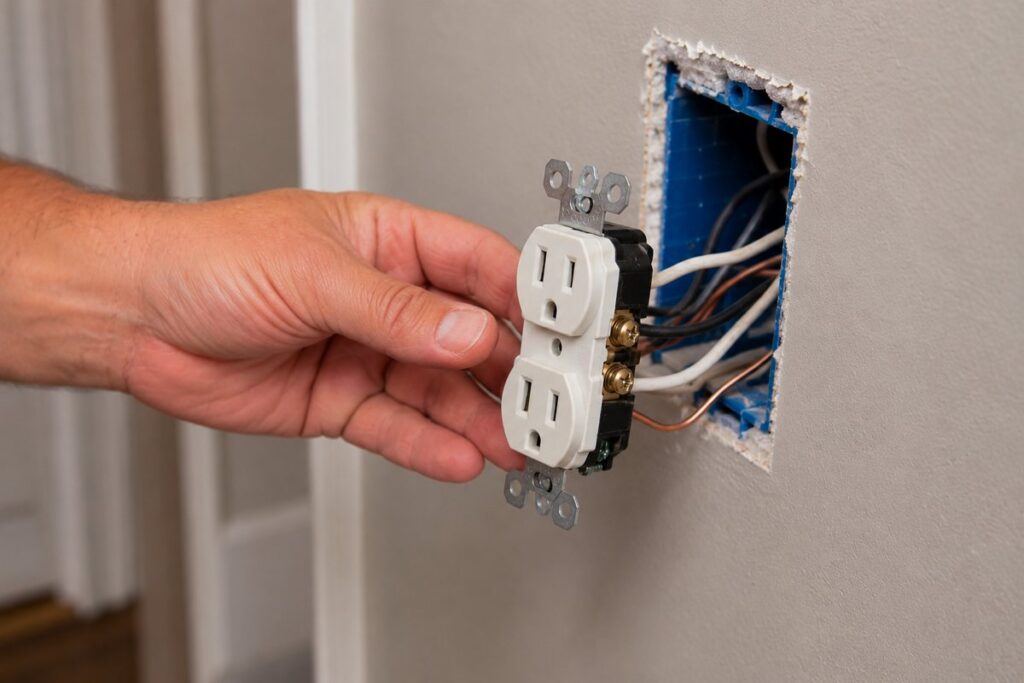
The word to know here is receptacle. That is the trade term for what most people call an outlet. The receptacle is the device itself, the thing screwed into the box in the wall, and it is a part that gets replaced on its own without touching the wiring behind it in most cases.
The short version: a plug cap is something you add and remove. A tamper-resistant receptacle is built into the wall and does its job on the day nobody remembered to put the cap back.
How can I tell if I already have them?
Shine a light into the slots and look.
A tamper-resistant receptacle has shutters sitting right behind the face, and with a flashlight you can see them. The slots look closed off, like there is a little plastic door in the way, because there is one. An older receptacle looks like an open hole into the box behind it.
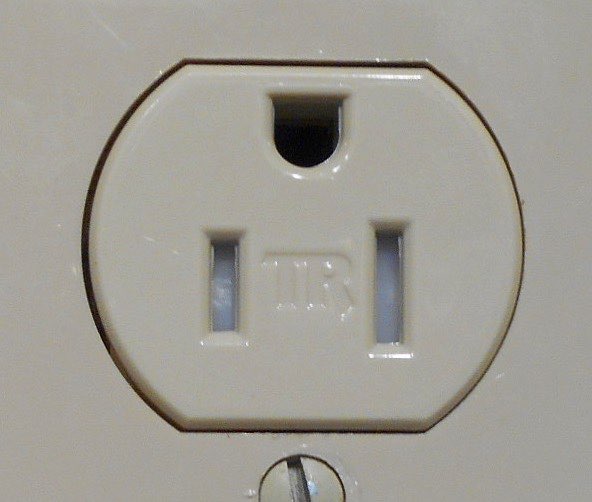
Most of them are also stamped with the letters TR on the flat part of the face, and that is quicker than the flashlight when it is there. We would not treat a missing stamp as proof of anything, though. Markings vary between manufacturers and by how old the device is, and the stamp is small and easy to miss even when it is present. The shutters do the actual work, so the shutters are what we would look at.
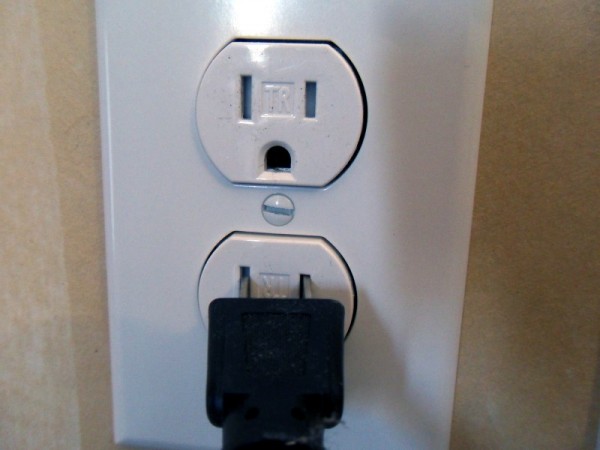
This is worth doing as a walk through the whole house rather than a spot check, because houses get remodeled in pieces. It is common around here to find a kitchen and a bathroom with TR receptacles and three bedrooms still on the original devices from whenever the house was last wired.
Are plastic plug covers still worth using?
They still do the job they were built to do. If you have older receptacles and small children in the house, a cap in an unused outlet is better than an open slot.
You already know the catch, because you have lived it. A good cap is hard to pull out on purpose, which is exactly the point, and it also means you are prying at the wall with a fingernail while holding a vacuum cleaner in your other hand. Then it goes on the end table, or in a pocket, or on the floor where the toddler finds it, and the small ones are a choking hazard in their own right. A cap protects the outlet it is in, and only while it is in.
That is where a lot of people stop fighting them. Rather than keep track of a dozen little pieces of plastic, they have the receptacles themselves swapped for tamper-resistant ones and stop thinking about it. The caps did not fail anybody. The protection just works better when it lives inside the device and nobody has to remember anything.
What if my outlet only has two slots?
Then tamper resistance is not the first thing to solve, and we have written about that one separately.
Two slots means there is no equipment grounding conductor at that device. That is the third wire, the one that gives fault current a path back to the panel instead of through a person. Older homes around Burlington, Fort Madison and Keokuk were wired before that was standard. We walk through the ways to correct a two-slot outlet here.
One thing worth adding, because it is what makes this a job for somebody with a meter rather than a Saturday project. Many of those older devices are mounted in metal boxes. If a hot conductor makes contact with a metal box that has no ground, the box itself can become energized, and so can the screws and the cover plate you put your hand on. Troy has opened plenty of these.
Does the code require them?
On new residential work, yes. When a house is wired today, or a room is rewired during a whole home rewire, the receptacles going in are tamper resistant.
We are not going to print a code section or a code year on this page, and that is on purpose. Electrical code gets revised on a cycle, states adopt those revisions on their own schedule, and Iowa has had real movement in the last year. Whatever we printed today could be out of date by the time you found this page. If you want the requirement that applies to your address, ask whoever is pulling the permit. If that is us, we will tell you straight.
One word here matters, and it is the word the manufacturers chose carefully. These are tamper resistant, not tamper proof. A determined adult with a screwdriver can defeat one. What they are built to stop is a small child with a household object, and that is the situation that actually sends people to the emergency room.
So if you are only going to change some of them, start where the children are. Bedrooms, playrooms, the outlet behind the couch that a toddler can get to and you cannot.
What does it cost to change them out?
Swapping receptacles is one of the more common jobs we do, and the number depends almost entirely on what we find when we take the first cover plate off. A house with grounded wiring and standard boxes is straightforward. A house with metal boxes, no grounds, and connections made on the back of the old devices is a different job, and we would rather tell you that on day one than halfway through.
We publish our pricing rather than making you ask for it. The price we publish is the price we quote. What we cannot do is put a number on your house before we have looked at it, and we would not trust anyone who did.
The one thing to do tonight
Go look at three outlets. One in a bedroom, one in the kitchen, one in the oldest part of the house. Check for the TR stamp and count how many slots each one has.
Whatever you find, you will know more about your own house than you did this morning, and you will know which question to ask next.
By Brent Allen Strawhacker | Marketing Director, T.A.P. Electric | West Burlington, Iowa